
 PhD Candidate
I am Tian Zhu (朱天 in Chinese), a PhD candidate at LPDI group, École Polytechnique Fédérale de Lausanne (EPFL) under the co-supervision of Professor Bruno Correia (EPFL) and Michael Bronstein (AITHYRA & University of Oxford). I am also a recipient of the Boehringer Ingelheim Fonds (BIF) PhD Fellowships for my research in computational protein design and geometric deep learning.
My research focuses on the computational protein design and geometric deep learning for scientific discovery. I am particularly passionate about leveraging AI for drug discovery and design. My goal is to develop effective AI methods to accelerate advancements in medicine and therapeutics.
Alone we can do so little; together we can do so much. I am always open to collaborations and discussions. Please feel free to reach out to me if you are interested in my research or have any questions.
NEWS: I am looking for self-motivated master students to collaborate on research projects,.
Warning
Problem: The current name of your GitHub Pages repository ("Solution: Please consider renaming the repository to "
http://".
However, if the current repository name is intended, you can ignore this message by removing "{% include widgets/debug_repo_name.html %}" in index.html.
Action required
Problem: The current root path of this site is "baseurl ("_config.yml.
Solution: Please set the
baseurl in _config.yml to "Education
-
École Polytechnique Fédérale de LausanneSep. 2025 - present
-
 AITHYRA Research Institute for Biomedical Artificial IntelligenceJun. 2026 - present
 -
 Chinese Academy of SciencesSep. 2022 - Jul. 2025
 -
 Beijing Institute of TechnologySep. 2018 - Jul. 2022
Experience
-
 ByteDanceMay. 2025 - Nov. 2025
Academic Service
-
Conference Reviewer: NeurIPS, ICLR, ICML2025, 2026
-
Organizer: AMLD 20262026
News
-
I was awarded by Boehringer Ingelheim Fonds (BIF) PhD fellowships, which is highly competitive, with less than 10 % of applicants receiving a fellowship.
-
Life update: I have started my doctoral studies under co-advised by Prof. Bruno Correia and Michael Bronstein at the LPDI, EPFL, and I hope to enjoy a meaningful research journey!
Selected Publications view all
 SELECTED
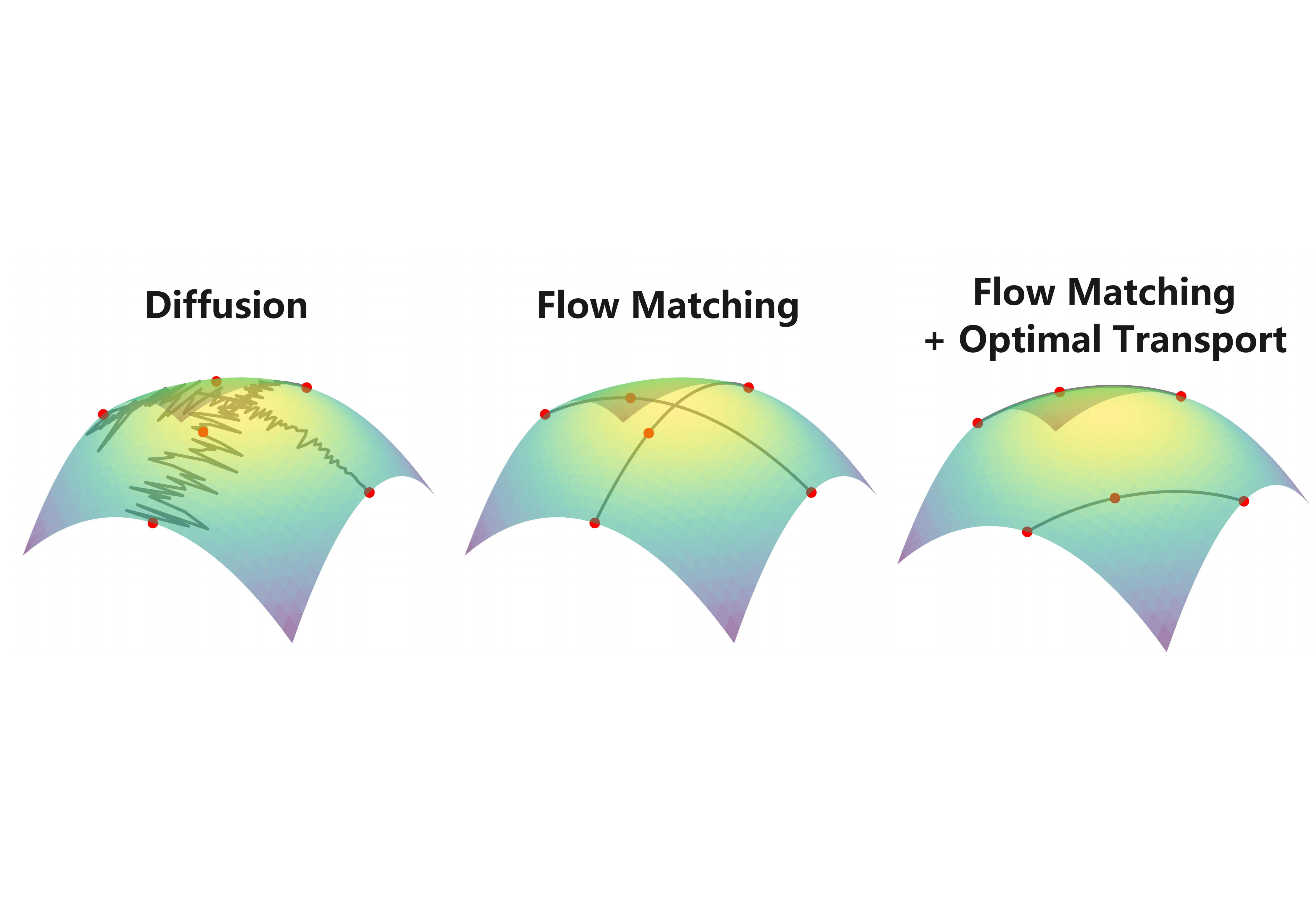
GGFlow: A Graph Flow Matching Method with Efficient Optimal Transport
Xiaoyang Hou*, Milong Ren, Dongbo Bu, Xin Gao, Chunming Zhang, Shiwei Sun (* equal contribution)
AIDrugX Workshop, Neural Information Processing Systems (NeurIPS) 2024 Transactions on Machine Learning Research (TMLR) 2025 14 citations
Generating graph-structured data is crucial in various domains but remains challenging due to the complex interdependencies between nodes and edges. While diffusion models have demonstrated their superior generative capabilities, they often suffer from unstable training and inefficient sampling. To enhance generation performance and training stability, we propose GGFlow, a discrete flow matching generative model incorporating an efficient optimal transport for graph structures and it incorporates an edge-augmented graph transformer to enable direct communications among edges. Additionally, GGFlow introduces a novel goal-guided generation framework to control the generative trajectory of our model towards desired properties. GGFlow demonstrates superior performance on both unconditional and conditional generation tasks, outperforming existing baselines and underscoring its effectiveness and potential for wider application.
GGFlow: A Graph Flow Matching Method with Efficient Optimal Transport
Xiaoyang Hou*, Milong Ren, Dongbo Bu, Xin Gao, Chunming Zhang, Shiwei Sun (* equal contribution)
AIDrugX Workshop, Neural Information Processing Systems (NeurIPS) 2024 Transactions on Machine Learning Research (TMLR) 2025 14 citations
Generating graph-structured data is crucial in various domains but remains challenging due to the complex interdependencies between nodes and edges. While diffusion models have demonstrated their superior generative capabilities, they often suffer from unstable training and inefficient sampling. To enhance generation performance and training stability, we propose GGFlow, a discrete flow matching generative model incorporating an efficient optimal transport for graph structures and it incorporates an edge-augmented graph transformer to enable direct communications among edges. Additionally, GGFlow introduces a novel goal-guided generation framework to control the generative trajectory of our model towards desired properties. GGFlow demonstrates superior performance on both unconditional and conditional generation tasks, outperforming existing baselines and underscoring its effectiveness and potential for wider application.
 SELECTED
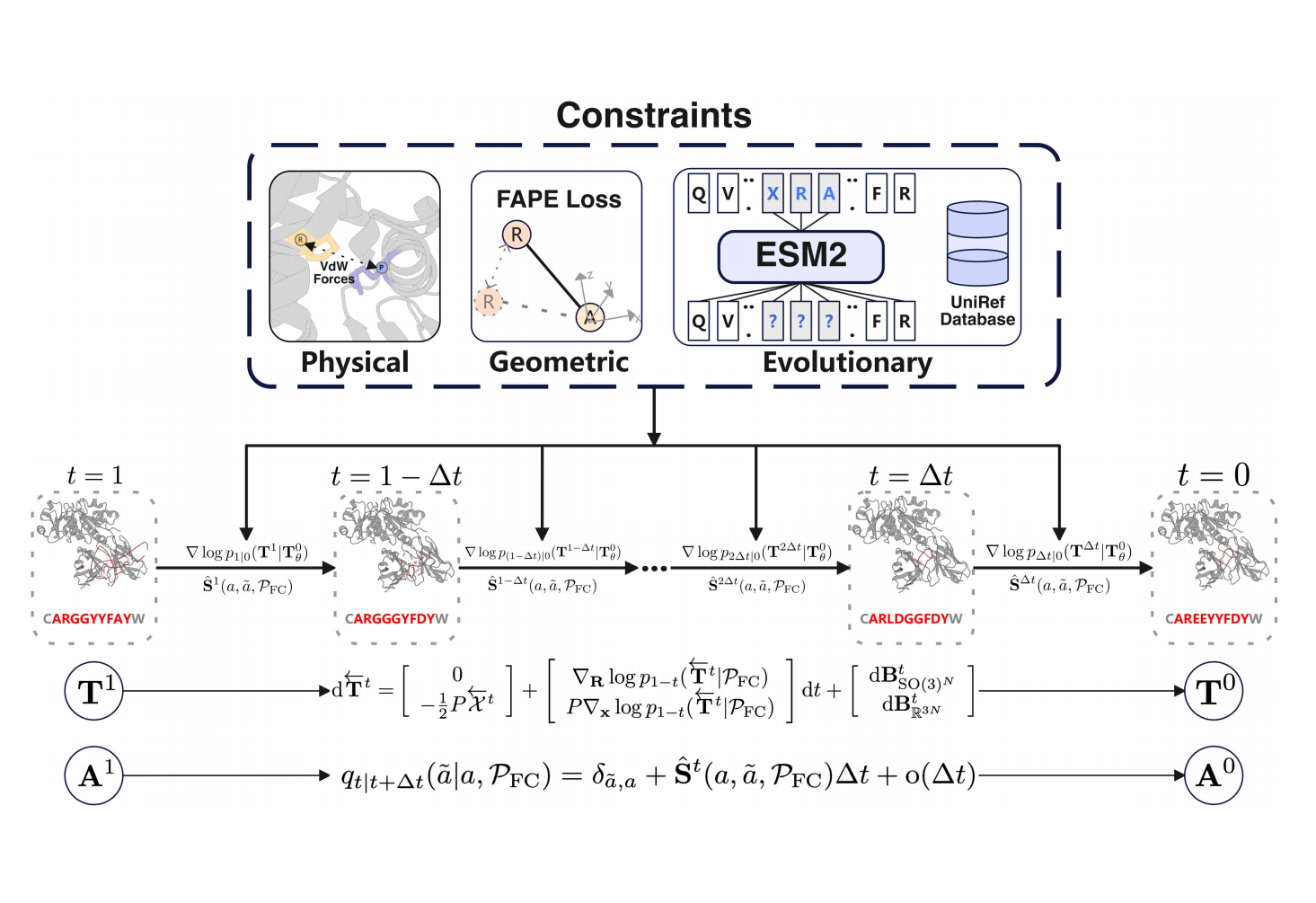
Antibody Design Using a Score-based Diffusion Model Guided by Evolutionary, Physical and Geometric Constraints
Milong Ren, Haicang Zhang
International Conference on Machine Learning (ICML) 2024 34 citations
We present AbX, a new score-based diffusion generative model guided by evolutionary, physical, and geometric constraints for antibody design. These constraints serve to narrow the search space and provide priors for plausible antibody sequences and structures. Specifically, we leverage a pre-trained protein language model as priors for evolutionary plausible antibodies and introduce additional training objectives for geometric and physical constraints like van der Waals forces. Furthermore, as far as we know, AbX is the first score-based diffusion model with continuous timesteps for antibody design, jointly modeling the discrete sequence space and the $SE(3)$ structure space.
Antibody Design Using a Score-based Diffusion Model Guided by Evolutionary, Physical and Geometric Constraints
Milong Ren, Haicang Zhang
International Conference on Machine Learning (ICML) 2024 34 citations
We present AbX, a new score-based diffusion generative model guided by evolutionary, physical, and geometric constraints for antibody design. These constraints serve to narrow the search space and provide priors for plausible antibody sequences and structures. Specifically, we leverage a pre-trained protein language model as priors for evolutionary plausible antibodies and introduce additional training objectives for geometric and physical constraints like van der Waals forces. Furthermore, as far as we know, AbX is the first score-based diffusion model with continuous timesteps for antibody design, jointly modeling the discrete sequence space and the $SE(3)$ structure space.
 SELECTED
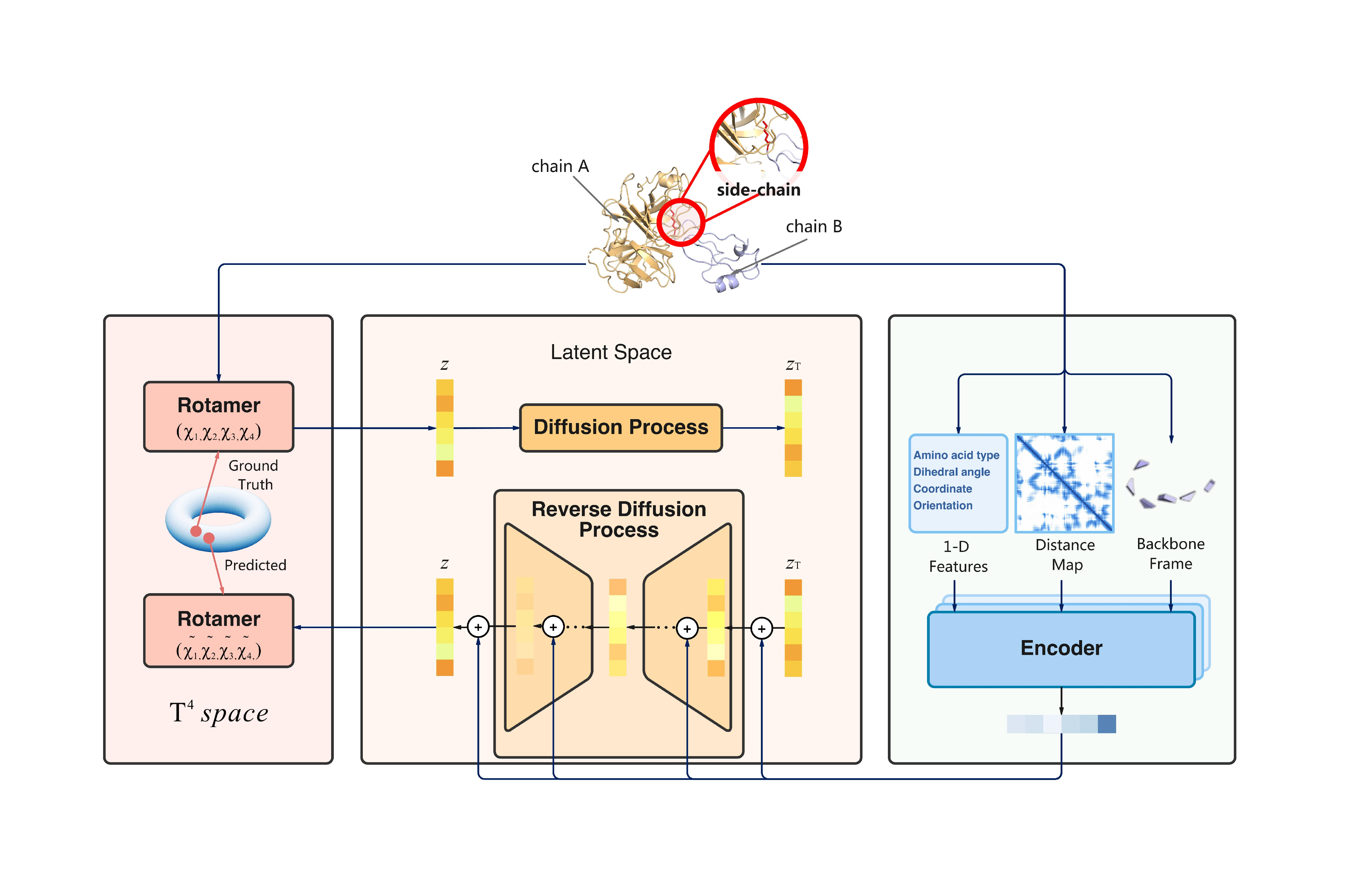
Predicting mutational effects on protein-protein binding via a side-chain diffusion probabilistic model
Shiwei Liu*, Milong Ren, Chungong Yu, Dongbo Bu, Haicang Zhang (* equal contribution)
Neural Information Processing Systems (NeurIPS) 2023 45 citations
In this work, we propose SidechainDiff, a representation learning-based approach that leverages unlabelled experimental protein structures. SidechainDiff utilizes a Riemannian diffusion model to learn the generative process of side-chain conformations and can also give the structural context representations of mutations on the protein-protein interface.
Predicting mutational effects on protein-protein binding via a side-chain diffusion probabilistic model
Shiwei Liu*, Milong Ren, Chungong Yu, Dongbo Bu, Haicang Zhang (* equal contribution)
Neural Information Processing Systems (NeurIPS) 2023 45 citations
In this work, we propose SidechainDiff, a representation learning-based approach that leverages unlabelled experimental protein structures. SidechainDiff utilizes a Riemannian diffusion model to learn the generative process of side-chain conformations and can also give the structural context representations of mutations on the protein-protein interface.
All publications
Honors & Awards
-
2026
-
Director's Outstanding Scholarship, ICT2023
-
Outstanding Graduating Student, BIT2022
-
National Scholarship, China "(Highest Honor for Chinese Undergraduates)"2021